

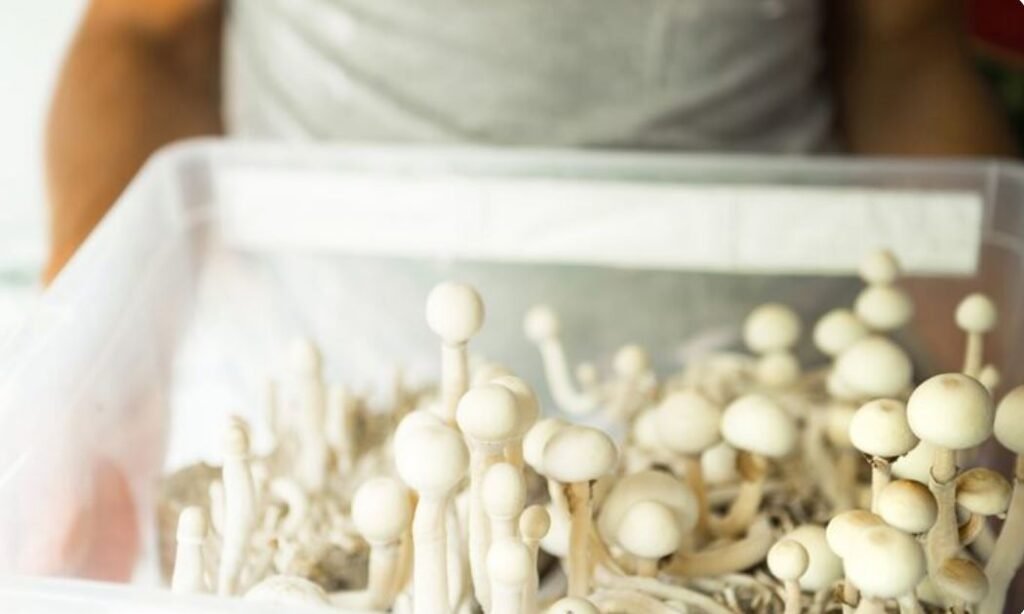
A subtle but significant shift is occurring in design studios around the world. Mushrooms are becoming the newest building partners for architects. They are growing materials that are remarkably efficient and sustainable by using mycelium, the thread-like root system of fungi, rather than just concrete or steel. This approach gives the impression that architecture is finally learning to work with nature rather than against it.
One of the main forerunners of this idea is David Benjamin, the architect of The Living. His Hy-Fi installation at the Museum of Modern Art in New York in 2014 became a seminal experiment in what he refers to as “living architecture.” The project, which was constructed entirely of mycelium bricks, demonstrated that robust, biodegradable materials could take the place of conventional building materials. The bricks were just put back into the ground after being disassembled. With no waste, no residue, and only renewal, the procedure was remarkably similar to nature’s own recycling system.
| Aspect | Details |
|---|---|
| Core Concept | Mycelium serves as a living, biodegradable material grown from organic waste to create sustainable building elements. |
| Environmental Benefits | Carbon sequestration, full compostability, toxin-free insulation, and zero-waste production cycle. |
| Leading Innovators | David Benjamin (The Living), Arthur Huang, Chris Maurer, Ecovative Design, PLP Labs. |
| Major Projects | Hy-Fi Tower at MoMA, Oakland Mycelium Housing Project, Symbiocene Living installation. |
| Broader Impact | Encourages circular construction methods and reduces dependency on carbon-intensive materials like concrete. |
| Authentic Source | National Geographic – “Mushrooms Inspire Engineers to Build a Better Future” |
Benjamin continues to work toward that goal. His group is building a 300-unit affordable housing complex with mycelium-filled insulation panels in Oakland, California. The team has developed a “mushroom sandwich” in partnership with Ecovative and Factory OS, which consists of a fiberglass shell encircling a composite core made of mycelium and hemp. This carbon-negative, lightweight, and incredibly efficient building provides a preview of what cities might look like in the future when materials are grown rather than manufactured. The project’s goal is very clear: integrate sustainability and social housing in a way that is inspiring and feels doable.
Mycelium’s dual purpose of actively cleaning the environment and replacing hazardous materials makes it especially novel. It absorbs agricultural waste as it grows, neutralizing toxins and storing carbon. For this reason, structural engineer and sustainability advocate Arthur Huang refers to it as “the holy grail of materials.” It’s both creation and restoration, product and process. The environmental advantages outweigh those of concrete, whose production contributes almost 10% of the world’s CO₂ emissions. Each mycelium block, panel, or brick symbolizes not only construction but also the elimination of carbon.
With his firm Redhouse Architecture, architect Chris Maurer has shown just as much audacity by launching portable “biocyclers.” By using the debris from buildings that have been demolished, these mobile labs are able to cultivate mycelium materials right on the spot. The concept, which uses biology as the builder to turn destruction into regeneration, is especially helpful in disaster areas. It’s a method that combines creativity and empathy in a way that feels incredibly realistic.
“Symbiocene Living,” a 2023 installation by PLP Labs that explores a future in which constructed environments change in tandem with nature, was first shown in Europe. Imagine interiors that gracefully decompose when no longer needed, walls that mend themselves, and facades that grow their own insulation. The notion questions the conventional wisdom that durability equates to value. In this instance, impermanence transforms into beauty, a notion that is both artistically and environmentally vital.
The benefits go beyond appearances. Materials made of mycelium are inherently non-toxic, fire-resistant, and acoustically absorbent. By removing the dangerous chemicals present in many traditional insulations, they are especially advantageous for indoor air quality. They are also incredibly durable under controlled conditions and surprisingly inexpensive to produce. Architects are using agricultural waste, such as sawdust, hemp fibers, or corn stalks, to create structures that can endure for decades while still returning to the earth when their useful lives are over.
The adaptability of this material is so remarkable that it inspires industries beyond architecture. Fashion brands like Hermès and Stella McCartney have already used mycelium-based leather substitutes in handbags and accessories, and the automotive industry is also experimenting with them. Even automakers like Kia have joined forces with Mycel of South Korea to create eco-friendly substitutes for automobile interiors. These developments show how fungi, which were previously disregarded, are now influencing design discussions in everything from couture studios to building sites.
But there are still difficulties. Mycelium composites still lack universal certification and need regulated growth conditions. Currently, only non-load-bearing applications can use them. However, research is moving at a noticeably faster rate. Reinforced fungal composites are being tested by teams at MIT and the European Union’s Horizon research program. These materials may be as strong as plasterboard or plywood while still being biodegradable. Thus far, the outcomes have been exceptionally successful, and the direction is encouraging.
Additionally, designers and architects are capitalizing on a broader cultural trend—the increasing interest in biomimicry. We are now designing homes and cities to reflect the patterns, processes, and resilience found in nature. The idea is refreshingly straightforward: let decay become a part of design rather than its failure, build as ecosystems build, and reuse as they reuse. It’s a way of thinking that turns sustainability from a to-do list into an innovative task.
The public’s interest has also increased quickly. While YouTube creators and design influencers display mushroom bricks and biocomposites with infectious enthusiasm, documentaries such as Fantastic Fungi have contributed to the mainstream conversation about this scientific renaissance. The concept of “growing buildings” seems less like science fiction and more like a given. People are starting to realize that sustainable architecture can mean reinvention rather than compromise.
Perhaps the most encouraging aspect of this strategy is how it transforms the connection between people and material culture. For centuries, extraction—digging, refining, and burning—was the definition of progress. Progress is now starting to resemble cultivation. In addition to producing sustainable materials, mycelium architects are fostering a relationship with the natural world. Cities are being rethought as living ecosystems that can breathe, change, and recover.
The design industry is not just experimenting with a new building material by adopting mycelium. It is changing the definition of responsible building. This movement celebrates cycles, growth, and eventual return rather than sterile perfection or unending durability. The idea is incredibly hopeful: each structure made of fungi has the capacity to dissolve gracefully, enhancing the soil for future growth.
That may be the most poetic aspect of all. After years of obsession with permanence, architecture is finally learning to break down gracefully. Perhaps something far more living—a substance that literally grows with us and listens to the rhythm of nature—will be used to build the future instead of steel or stone.
