

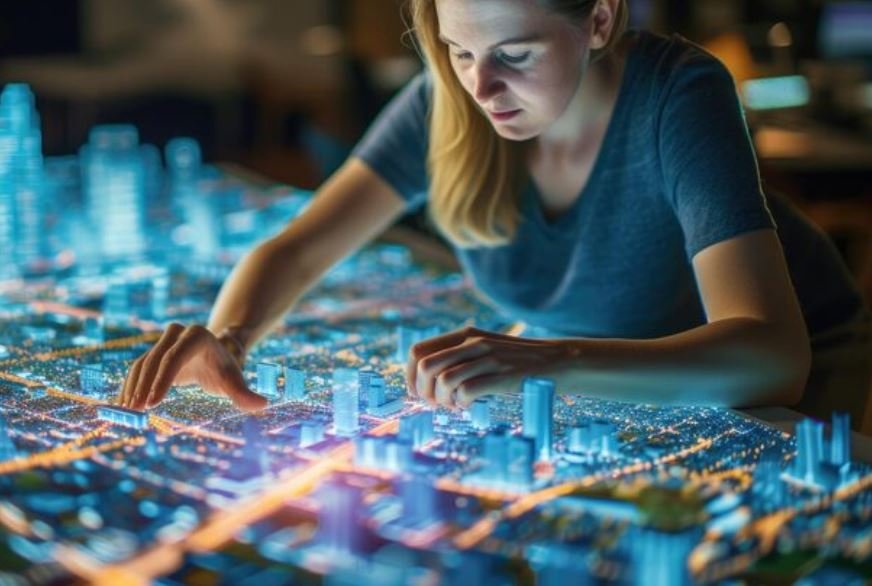
Modern city skylines are still dominated by concrete and cranes, but a more subdued change is taking place. With its ability to read patterns that are invisible to the human eye, artificial intelligence is quickly emerging as a planner’s most useful ally. Algorithms now influence neighborhood growth, zoning decisions, and even routes in Phoenix, Tempe, and Singapore. It’s a shift as significant as the switch from drafting tables to digital design. The tools are thinking back this time, though.
AI gives cities a very useful assistant that can process enormous amounts of data more quickly than a human could. Consider a system that anticipates urban sprawl, learns traffic patterns, and identifies flood zones before any rain ever falls. AI can translate chaos into coordination by interpreting a city’s pulse in addition to processing numbers. This technology feels like a second brain to planners who have been hampered by antiquated models and scarce resources for a long time.
| Aspect | Details |
|---|---|
| Core Concept | Artificial Intelligence guiding urban design through data analysis, prediction, and automation |
| Key Benefits | Sustainability, cost efficiency, real-time adaptability, and inclusive design (when used responsibly) |
| Technologies Involved | Digital twins, generative AI, data-driven zoning, smart mobility systems |
| Global Examples | Phoenix’s AI traffic optimization, Helsinki’s energy-mapping twin, Singapore’s urban forecasting |
| Major Ethical Concerns | Algorithmic bias, privacy, and erosion of local identity |
| Authentic Source | Johns Hopkins University – AI and the Future of Cities (carey.jhu.edu) |
AI-guided transit systems that react dynamically to real-time data are already being tested in Phoenix under Mayor Kate Gallego. Traffic lights adjust for weather, vehicle flow, and pedestrian density. It is very effective at lowering emissions and traffic at the same time. Gallego’s method is still human-centered, though. Although AI can optimize operations, she maintains that only humans can determine what “better” actually means for a community. The future of planning is defined by this distinction between intent and intelligence.
Digital twins are changing the way people envision urban landscapes elsewhere. Planners can model new developments before laying a single foundation thanks to Helsinki’s city twin, which replicates everything from energy consumption to mobility patterns. In terms of climate resilience, it’s especially inventive because it allows the city to predict rising temperatures and modify energy distribution appropriately. A similar approach has been used in Singapore, where public housing projects and green corridors are planned years in advance of demand using AI forecasts. These tools are enhancing creativity rather than displacing it.
Even walkability is being assessed at Virginia Tech using generative AI. Thousands of street-level photos are scanned by algorithms to find areas that lack shade, crosswalks, or benches. It now takes hours to complete manual surveys that used to take weeks. Planners can reclaim time for strategic, human-focused work that focuses on how cities feel rather than just how they operate by automating routine assessments. This change, which combines accuracy and compassion, is significantly enhancing quality-of-life planning.
Nevertheless, each algorithm has its own prejudices. AI that is trained on historical data may inadvertently perpetuate historical injustices by allocating resources to regions that have already benefited from prior planning choices. “AI can be as fair or as flawed as the history it learns from,” cautions planning expert Tom Sanchez. In cities where predictive zoning models run the risk of reiterating invisible divides, this realization is especially evident. AI might turn into a digital relic of the past rather than a tool for advancement in the absence of diverse datasets.
The question of how AI should plan cities is up for debate, not if it should. Stephanie Deitrick, Tempe’s chief data officer, has been developing a moral AI policy based on human responsibility. Her tenet is straightforward but impactful: accountability must never be replaced by automation. There needs to be a human steward for each AI-generated recommendation—someone who can clarify, challenge, and, if required, override it. Cities all over the world are starting to adopt this remarkably obvious position. Tempe is establishing technological trust from the ground up by integrating ethics into the design process rather than as an afterthought.
Another issue is privacy. The fervor for “smart cities” has occasionally verged on surveillance. The Sidewalk Labs project in Toronto promised sensor-powered sustainable design, but it fell apart when the public saw it. People were concerned that their whereabouts and behaviors could be used as commercial information. Progress without transparency breeds suspicion, as that backlash served as a reminder. Planners must make sure the city is monitored for improvement rather than for financial gain as they incorporate AI.
The trend toward AI-driven planning is unstoppable, and maybe for good reason, despite these reservations. AI is now used by Seoul’s emergency management systems to plan disaster responses and send out resources incredibly quickly. Predictive AI-managed water systems in Amsterdam have significantly enhanced flood control. These examples demonstrate how AI can not only analyze issues but also prevent them when data is used responsibly. In emergency situations where seconds determine the outcome, the technology is extremely effective.
AI offers creative possibilities in addition to functionality. Using generative design tools, architects are creating urban layouts that are modeled after natural systems, such as parks that align with the seasons, buildings that are shaped for airflow, or streets that resemble river flows. It is a very flexible process that combines algorithmic reasoning with human creativity. It alludes to a new era in which cities are not just constructed but also composed, with every choice being crafted like a note in the greater urban symphony.
However, involvement is arguably the most significant component of AI planning. Residents have recently viewed proposed developments in virtual reality prior to approval by using visualization tools driven by artificial intelligence. By bridging the gap between lived experience and technical language, these immersive experiences enable citizens to participate more fully. It’s a significantly better kind of democracy that is both emotionally and factually based.
Creative and cultural leaders are also contributing. Though they may seem unrealistic, Elon Musk’s discussion of algorithmic design for Martian colonies and Christopher Nolan’s depiction of AI-powered cities both point to the reality that artificial intelligence is already changing how people envision their shared environments. The software scaffolding for this creativity is now offered by firms like Siemens and Nvidia, transforming intricate data ecosystems into easily navigable design platforms. As a result, engineers, sociologists, and artists are working together more and more to co-create rather than compete.
Algorithms will not replace tomorrow’s urban planners; rather, they will elevate them. AI enhances human interaction rather than replaces it. It relieves planners of the technical burden, allowing them to dream, empathize, and design with intention. The collaboration is especially helpful in tackling issues like equitable infrastructure, climate adaptation, and housing shortages. Cities can become living systems—responsive, sustainable, and incredibly human—through careful integration.
