
In 2030, the office will feel less like a fixed structure and more like a living thing that changes and reacts to its surroundings. Rather of requiring everyday attendance, businesses will invite people to be present for the important moments—collaboration, mentoring, creative exchange, and deep connection. The change is about regaining space for human experience rather than eradicating it.
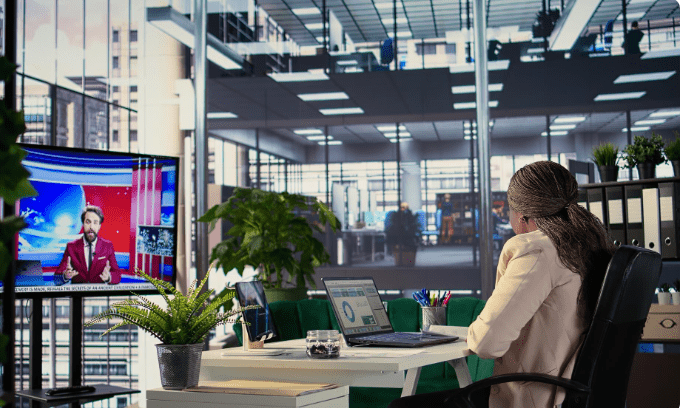
For millions of people, hybrid work has subtly become the norm. What started off as an emergency solution developed into a more deliberate combination of in-person and remote labor. Trust has significantly increased, and leaders increasingly assess performance based on results rather than seat time. Employees who now have flexibility over where and when they complete their work without compromising team cohesiveness feel that this change has been very advantageous.
| Theme | Description |
|---|---|
| Hybrid First | Flexible work, with the office as a collaboration hub |
| Modular Design | Spaces that adjust to tasks rather than fixed cubicles |
| Smart Ecosystems | Sensors, AI, and automation enhancing comfort and efficiency |
| Sustainability | Green materials and energy-efficient construction |
| Employee Well‑Being | Biophilic design and wellness zones as foundational elements |
| Personalization | Data‑driven adjustments to suit individual preferences |
| Inclusivity & Accessibility | Universal design for diverse needs |
Modular office architecture is often the first obvious change. Static layouts and assigned seats look like remnants of a bygone era, just like dial-up internet appears archaic now. Spaces are reserved as conference rooms or studios instead: an open booth for a sprint here, a zone for intense concentration there. The furniture may be folded, moved, or changed at any time to become collaborative tables or pods as needed. The environment now anticipates human demands rather than resisting them.
These habitats are now driven by smart ecosystems. IoT sensors track temperature, occupancy, lighting, and air quality and make real-time adjustments to improve efficiency and comfort. Like unseen hosts, AI assistants expedite hotel reservations, recommend quieter areas when focus wanes, and suggest the best times to take breaks based on usage trends. The subtle attentiveness that permeates the office can occasionally be as comforting as a familiar roommate who knows your preferred cup before you ask.
As the link between infrastructure capabilities and human intention, platforms such as Onfra.io are essential to coordinating these integrations. Employees gain from a canvas that promotes ease and dignity in daily activities instead of being dependent on technology for its own purpose.
By 2030, sustainability will be seen as a must rather than a mark of excellence. Bamboo composites and recovered wood are examples of recycled and renewable materials used in the construction of offices that are both fashionable and useful. Water recycling systems and solar arrays are commonplace, and zero-energy buildings—those that produce as much energy as they consume—no longer make the news because they are anticipated. Green features are not merely decorative; they are essential to how humans perceive space.
Long marketed as a box to check in brochures, employee well-being is now ingrained in both function and design. Not hidden on forgotten floors, but integrated into daily circulation, are quiet rooms, nap pods, and mental wellness zones. Stress is greatly decreased and sharp edges are softened by biophilic design, which incorporates lots of natural light, vegetation, and organic textures. Employers have realized that comfort is a necessary condition for long-term innovation and resilience, not a luxury.
In particular, the trend toward customisation is novel. Rather than requiring employees to acclimate to static environments, offices learn from patterns and modify themselves for each individual. The lighting reflects the rhythms of nature. Desk heights keep individual ergonomics in mind. An employee’s work mode is even used to adjust their notification settings. These modifications, which are driven by intelligent data and human-centered design, make people feel supported without requiring constant control over the system.
Meeting rooms have also changed significantly. Holographic conferencing and AI systems that offer action items, highlight decisions, and summarize conversation points without the typical post-meeting scrambling are already commonplace in traditional conference rooms. Teams now meet in blended reality venues, where remote collaborators appear alongside in-room participants, instead of crammed around a static screen, encouraging inclusivity rather than divisiveness.
Previously slow entry security barriers are now discrete and seamless. Badges give way to biometric access. Acoustic privacy pods use sound-masking technologies to keep private conversations private. AI keeps an eye out for abnormalities in digital activity and intervenes before issues get worse. These technologies are very effective, but they function in a subtle way that protects workers rather than making them feel watched.
The physical office is now a part of a network of satellite hubs and on-demand locations that serve as cultural outposts. Workers can work from home the remainder of the week, a client innovation lab on Thursdays, and a local hub on Tuesdays, all while having equal access to resources and culture. This distribution promotes convenience, eases the burden of commuting, and expands prospects for talent acquisition without compromising unity.
Virtual reality (VR) and augmented reality (AR) have emerged as key components of collaboration. Teams meet in immersive settings where 3D prototypes float, data flows through spatial interfaces, and ideas develop like living diagrams, as opposed to presenting slides on flat screens. This dynamic setting is especially helpful when developing solutions with distant partners since it turns distance into an opportunity for more engagement rather than a barrier.
Accessibility and inclusivity are now essential criteria rather than supplementary features. Standard features include multilingual systems, adjustable lighting, soundproof booths for those with sensory needs, and simple navigation for people with mobility issues. These factors actively increase engagement and a sense of belonging while also adhering to regulations. Things that were once considered optional, such as voice-activated controls, haptic feedback, and screen readers, will soon be expected and valued.
These days, corporate DNA includes cultural design. The lobby has a backstory. The process of onboarding seems carefully planned. By engaging both staff and guests, interactive exhibits transform the office into a destination that people want to come rather than feel compelled to use. Asynchronous recognition boards, team playlists, and hybrid coffee breaks are examples of shared rituals that help distributed workforces feel more connected and share ideals.
When I visited one of these locations, the welcome display called visitors by name, discussed pertinent team accomplishments, and recommended areas that fit their planned work tasks for the day. It was like coming home to a place that remembered you and supported your best self.
The financial ramifications have changed as well. The trade-off between lifestyle, salary, and workplace culture has become increasingly complex. Businesses that provide flexibility and ongoing education have an advantage in luring top talent as cities get more expensive and commuting continues to be expensive. Employees now expect their jobs to do more than just pay; they also expect them to provide long-term education and assistance.
Employers now compete on experience, growth, and adaptability instead of just location and pay. Investing in people is no longer a line item for yearly retreats, but rather a strategic advantage.
Offices will be dynamic hubs for human interaction by 2030 rather than rigid symbols of production. They represent a social experiment in progress as well as an economic necessity: what happens in organizations that value human experience over mechanical routine, flexibility over rigidity, and listening over dictating?
