

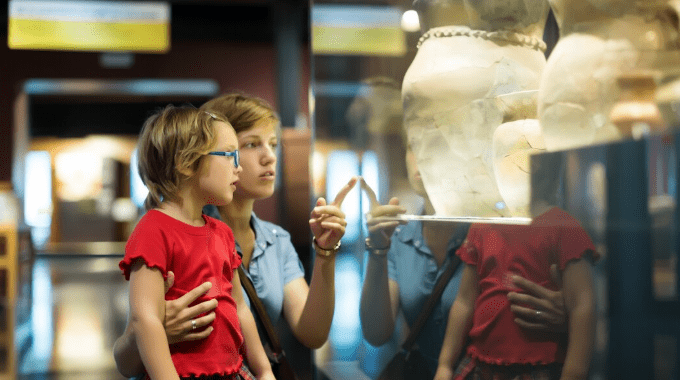
While schoolchildren huddle around maps that promise civilizations in every direction, visitors enter the Great Court of the British Museum, which is covered by glass, their footsteps resonating against the pale stone on a gloomy London morning.
Millions of items are stored in crates and drawers outside of the public galleries, where they are labeled, cataloged, and occasionally forgotten. By 2028, the museum hopes to have digitized its entire collection, which could make over eight million artifacts available online. It sounds like a big goal. It sounds long overdue, too.
| Category | Details |
|---|---|
| Institution | British Museum |
| Location | London, United Kingdom |
| Established | 1753 |
| Collection Size | 8+ million objects |
| Digitization Goal | Full digital documentation and public access |
| Timeline | Approx. 5-year digitization plan |
| Motivation | Improve access, security, research, and transparency |
| Notable Artefacts | Rosetta Stone, Parthenon Marbles, Egyptian antiquities |
| Recent Context | Security breaches and missing artefacts prompted reforms |
| Official Website | https://www.britishmuseum.org |
The initiative comes after a traumatic event. The museum disclosed in 2023 that thousands of items had been lost or stolen—an “inside job,” according to trustees—revealing gaps in oversight and documentation. The drive for digitization has accelerated since then. Visibility itself seems to be viewed as security: the more people who can see something, the more difficult it is for it to vanish.
The scale issue becomes apparent as one passes the Egyptian galleries where visitors use raised phones to take pictures of the Rosetta Stone. The museum’s collection is never shown in its entirety. The others are hidden from the public but are studied by academics in climate-controlled rooms. These hidden resources could become accessible to anyone with an internet connection thanks to digitization, which would make it possible to examine items that previously required institutional access and a research appointment.
It is anticipated that generative AI will contribute to this change by producing searchable metadata, repairing damaged inscriptions, and digitally reconstructing fragmentary artifacts. Incomplete records have long been a problem for museums; algorithms that are trained on visual patterns may be able to identify materials, origins, or motifs. These kinds of tools might speed up scholarship in ways that cataloguing couldn’t. How much interpretation should be left to machines is still up for debate, though.
The museum’s adoption of AI comes at a delicate time. It received criticism from archaeologists and heritage advocates in early 2026 after posting AI-generated promotional photos on social media. A tension was brought to light in that episode: although digital tools can increase access, they can also obfuscate authenticity. Curators tread these waters with a sense of caution and curiosity.
Additionally, digitization touches on long-standing discussions regarding cultural ownership. Other countries have pushed for the return of artifacts taken during colonial eras, while Greece is still demanding the return of the Parthenon Marbles. Transparency could be improved by a fully digital archive, which would enable nations and scholars to thoroughly study disputed artifacts. Instead of calming repatriation claims, some observers think this transparency could make them stronger.
Technicians already use specialized lighting to take pictures of delicate manuscripts inside conservation labs, capturing textures that are invisible to the human eye. It’s a methodical, slow, and oddly personal process. The act of a conservator using tweezers to manipulate a piece of papyrus is a centuries-old preservation ritual that comes before algorithms. Even though AI can expedite processes, the human hand is still essential for preserving the past from deteriorating.
The issue of experience is another. There is a tangible weight to standing in front of a sculpture that was carved 2,000 years ago; there is the scale, the surface, and the gallery’s collective silence. No matter how accurate, a digital model provides something unique. democratic, searchable, and useful. but distinct. It’s hard to miss how museums are simultaneously evolving into enormous data platforms and physical havens.
Cultural organizations around the world are rushing to digitize their holdings, collaborating with tech companies and testing out virtual exhibitions. Because of its size, the British Museum’s endeavor is particularly symbolic. If successful, it could change the way knowledge is shared, allowing students in places like Nairobi, Lahore, or São Paulo to study artifacts that were previously restricted by privilege and geography. Sensing the prestige and data value of such projects, investors and tech companies appear eager to support them.
But questions remain. Long-term funding, cybersecurity, and upkeep are necessary for digital archives. File formats change over time. Servers malfunction. Previously dependent on stone and climate control, preservation now relies on electricity and code. The museum is preserving not only artifacts but also pieces.
With their guidebooks and souvenir bags in hand, tourists hover around the information desk as afternoon light streams through the Great Court roof. There has always been a sense of the past being present at the museum. It is currently working to make that past searchable, universally visible, and somewhat flexible. It’s unclear if this endeavor broadens public awareness or merely alters how history is viewed.
Nevertheless, it seems as though the museum is reacting to a society that demands participation, openness, and accessibility as it attempts this change. At least in digital terms, the drawers are opening. Another question is what the world decides to do with what it discovers within.
