

There was real hope when Liverpool’s fleet of hydrogen buses was first unveiled. With fuel cell technology, the 20 shiny double-deckers arrived with promise. They were intended to signify a breakthrough in civic identity as well as sustainable transportation. However, that goal has subtly changed during the last 12 months.
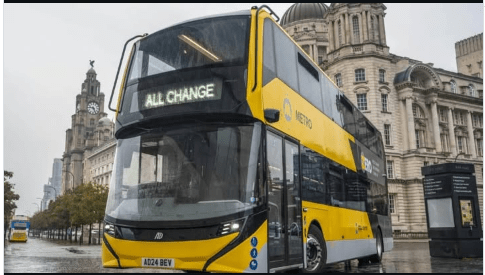
The city is changing course instead of abandoning the experiment. Once thought to be game-changers, the 20 hydrogen-powered buses are being converted to battery-electric power. Inconsistent hydrogen supply, especially high running costs, and buses that, despite their futuristic design, hardly serviced passengers are some of the lived restrictions that have driven this strategy recalibration.
| Key Detail | Description |
|---|---|
| Region | Liverpool City Region |
| Original Plan | 20 hydrogen buses delivered in 2023 under £10 million pilot |
| Change in Strategy | All hydrogen buses being converted to battery-electric by 2027 |
| Reason for Change | Fuel supply issues, high costs, low utilization |
| Broader Goal | Fully franchised, zero-emission bus network by 2027 |
| Funding Source | Transport for City Regions (TCR) investment |
| Additional Investments | Smart ticketing, £2 fare cap, depot upgrades, youth fare subsidies |
| External Reference |
The pivot provides clarity to the general audience. Although hydrogen is still a desirable alternative for long-distance or freight transportation, its viability for urban buses is currently being reevaluated. Including those under Stagecoach management, half of the fleet was never put to regular use. Arriva’s remaining ten were only occasionally used. Liverpool had officially secured a green hydrogen supply by the middle of 2024, but the infrastructure and dependability were still out of step with everyday service requirements.
Liverpool’s executives made a sensible decision: the cars need to change if they can’t leave the depot on a regular basis. Making them battery-electric is more than simply a temporary solution; it’s a reflection of how infrastructure, technology, and regional goals have more successfully converged. Although they don’t have the same mystery as hydrogen, battery-electric buses are today very effective, incredibly robust, and, most importantly, functional.
This is a redirection, not a defeat. A completely zero-emission bus network by 2027 is still the Combined Authority’s ambitious principal objective. However, it is leaning toward dependability rather than placing a wager on an elusive fuel. The change is really successful in that regard. More than 100 new electric buses have already been acquired, and money is being allocated to infrastructure—such as smart ticketing systems, charging stations, and extended youth price discounts—that supports everyday, public-facing success.
The actual investing plan is cleverly multi-layered. The city is reusing existing vehicles and reallocating Transport for City Regions (TCR) funds rather than spending more money to repeat the hydrogen rollout. The funds that were initially intended for innovation will now be used to support implementation. The program includes depot renovations, bus lanes, and interchanges. The £2 cap protects fare affordability, which is still a key component of the proposal.
According to Mayor Steve Rotheram, 2026 will be the most important year for transportation in the area. At that point, Liverpool reverses decades of deregulation by starting the transition to a franchised bus network. In St Helens and the Wirral, the new model’s initial services will be introduced. The entire regional rollout will be finished in a year. This pace is noticeably faster for a city that has always taken its time with transportation reform.
People’s firsthand experiences frequently influence public faith in climate measures. A news release promoting innovation makes less of an impact than a zero-emission bus that arrives on schedule. Liverpool’s electrifying transition is more convincing because of this. It is anchored, observable, and intended to produce outcomes.
Right now, goals and results are being rebalanced. Liverpool is proving that adaptability can be just as brave as forward-thinking by converting the fleet. This flexibility will be a helpful model for other cities considering comparable options. After all, changing lanes is not a bad thing, especially when the path ahead becomes more obvious.
The broader vision is still there. Liverpool continues to strive for net-zero emissions. It’s simply taking a very creative approach to achieving that goal, which is noticeably better than it was just two years ago and remarkably comparable to what several Scandinavian cities are doing.
Public transportation doesn’t have to strive for perfection, particularly when it is driven by local legislation. It must function reliably, effectively, and with sufficient adaptability. Liverpool’s decision to change direction on hydrogen demonstrates that systems that can meet public demand on a daily basis—rather than just ideally—best match aspiration.
If all goes as planned, Merseyside’s buses will be moving silently through communities by 2027, running on electricity, using a franchised model, and charging reasonable fares. The original dream might not have been that. However, the likelihood of it arriving on time is significantly higher.
