

Rúben Amorim’s signing with Manchester United in November 2024 felt more like a declaration of intent than a shift in management. He was not just the youngest United manager in decades at the age of 39, but he also represented a new era. The financial package demonstrated more than confidence, with a base pay reportedly set at £6.5 million annually, topped with performance-related bonuses raising the possible yearly earnings to £8.5 million. There was a hint of haste.
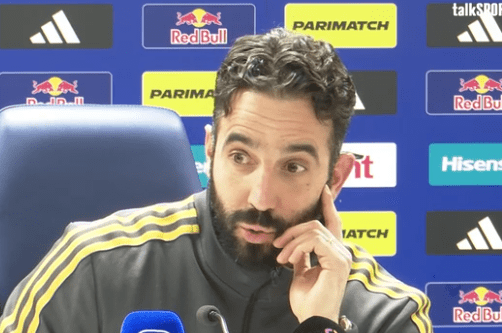
The choice to entice him away from Sporting CP wasn’t made lightly. United had already paid for the release clause in his last contract and committed to a multi-year plan that they believed would help them move from inconsistency to sustainability. However, the club secretly let him go by early January 2026, just 14 months into a contract that was supposed to last until 2027. This resulted in a severance compensation that was reported to be between £9.75 million and £10.05 million.
Rúben Amorim – Career & Salary Overview
| Name | Rúben Amorim |
|---|---|
| Born | January 27, 1985 – Lisbon, Portugal |
| Most Recent Club | Manchester United |
| Contract Period | Nov 2024 – Jan 2026 |
| Base Salary | £6.5 million per year |
| Bonus Potential | Additional £2 million per year |
| Total Payout | Approx. £27.35 million (incl. severance) |
| Previous Role | Sporting CP Manager (2020–2024) |
| Source |
Prior to United’s approach, Amorim had never managed outside of Portugal. Nevertheless, it was hard to overlook his influence at Sporting. After being hired in March 2020, he quickly changed the team’s style of play, encouraged young players, and helped them win the Primeira Liga championship—their first in almost 20 years. His ascent was remarkably quick and remarkably similar to the paths taken by the most sought-after European coaches of today.
By the time he left Sporting, his yearly salary was projected to be €2.5 million. Since his first appointment, that number has already doubled, a rise fueled by contract extensions based on performance, appearances, and the increasing demand from overseas. His transfer to United was, in many respects, a gamble on his potential as well as a recognition of his efforts. However, not every wager yields the desired results for teams.
Seldom did the reports about Amorim’s termination suggest scandal or catastrophe. Instead, everything came down to timing, outcomes, and the unseen line when patience is no longer justified by promise. Although the club had displayed moments of tactical finesse and discipline, they frequently lacked urgency at crucial times. Even with a well-rounded roster and weeks of preseason training, United found it difficult to put together reliable performances.
The game’s rhythm was what made an impact, even though the final result was 1-1. Even when his players missed easy opportunities, Amorim remained composed on the touchline, making precise hand gestures. I recall thinking, quite politely, that sometimes a bench’s stillness speaks louder than words.
It was evident that the board had changed course by January. The club decided to stem the bleeding early despite the high expense of ending his contract—more than £9 million—when considering the £27.35 million total financial commitment. Even so, in top football, this number is becoming less startling.
Managers are now seen as more than just tactical directors; they are brand ambassadors, cultural architects, and increasingly, catalysts for institutional impatience. The same has been true of salaries. When Amorim’s £6.5 million base was first revealed, sports finance columns were filled with rumors. However, his arrangement already seems like a step toward something more lavish, since some recent contracts exceed £10 million annually and include equity bonuses or commercial kickbacks.
The firing is hardly likely to be a turning point for Amorim. He is still youthful, smart, and grounded at 41 thanks to a sporting career that taught him to anticipate adversity. He does so with strengthened credentials—and a sizeable severance—whether he decides to play in the Premier League again, return to Portuguese football, or explore Serie A.
His brief stint at Manchester United may go down in history as just another botched comeback, but the lessons it taught us speak to larger realities. that youth and philosophy continue to entice premier clubs. that patience and chemistry are still necessary for strategic bets, regardless of how well-thought-out they are. Additionally, today’s contracts are more about terms—negotiated escape hatches wrapped in optimism—than tenure.
At the top level, Amorim’s earnings are becoming more and more normal, despite being unusual to most. However, the way the pay package was designed to reward both instant impact and long-term development is what makes his situation so unique. Many clubs are now following this model, which combines initial investment with safeguards against early termination.
This cycle—with Amorim, United, and seven-figure rewards woven into exit plans—feels both familiar and very illuminating. Football is frequently described in cycles.
