

The arrival of Bootlegger Coffee Company was quiet. Without dramatic branding or overblown claims, its first Sea Point roastery opened its doors in 2013. Instead, it relied on the straightforward belief that well-made coffee will speak for itself over time rather than require immediate attention.
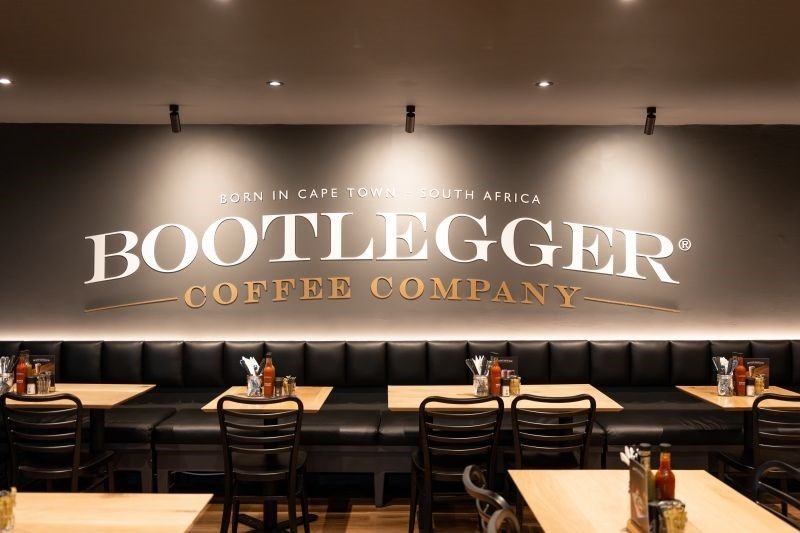
Over time, what started off as a little effort between three friends grew into something more substantial, methodical, and remarkably patient. It didn’t feel like a sprint to expand. The pace was adjusted without losing direction, and it proceeded more like a long walk, measured step by step.
| Item | Details |
|---|---|
| Company name | Bootlegger Coffee Company |
| Founded | 2013 |
| First location | Sea Point, Cape Town |
| Founders | Three privately held partners |
| Current footprint | 80+ cafés across South Africa |
| Expansion target | 200+ cafés by 2028 |
| Coffee sourcing | 100% Rainforest Alliance Certified |
| Roastery output | 350–400 tonnes annually |
| Bean origins | Costa Rica, Guatemala, Tanzania |
| Core philosophy | Quality, consistency, sustainability |
Early on, quality became the fulcrum. Bootlegger’s pledge to use exclusively Rainforest Alliance Certified beans was presented as an operational standard rather than a marketing gimmick. Long before sustainability became an industry standard rather than a differentiation, that choice influenced roasting techniques, price discipline, and sourcing connections.
The actual beans originate from Tanzania, Guatemala, and Costa Rica—regions renowned for their reliability rather than their uniqueness. With undertones of caramel, dark chocolate, and toasted hazelnut without going overboard, the final blend is very similar every day. This dependability is especially helpful for clients who come back for comfort rather than surprise.
The actual job is done elsewhere, behind the counter. With an annual production of between 350 and 400 tonnes, Bootlegger’s FSSC-certified artisanal roastery is currently one of the biggest micro roasteries in South Africa. Systems must be incredibly transparent and efficient to operate at that scale while maintaining flavor integrity.
Coordinating sourcing, roasting, and quality checks with an almost industrial calm, the roastery functions as a control tower. The avoidance of chaos is subtly impressive because small mistakes at this volume would quickly compound. Here, precision is incredibly useful, but it is not glamorous.
Food was no different. Instead of pursuing seasonal gimmicks or novelty menus, Bootlegger created an all-day café offering that would fit into everyday schedules. Without requiring consumers to rearrange their schedules to accommodate the brand, breakfast easily extends into lunch and lunch into dinner.
The use of seasonal, fresh, and mostly local ingredients has greatly decreased supply volatility while also improving consistency. The cuisine is meant to flow with the coffee, like parallel roads that never vie for attention, rather than to take away from it.
Expansion outside of Cape Town examined the viability of replicating these concepts. Café scaling is notoriously harsh, particularly when familiarity rather than spectacle shapes expectations. In response, bootleggers standardized processes while allowing for local expression—a combination that is still surprisingly challenging to achieve successfully.
Despite having similar characteristics, each café subtly changes to fit its environment. Layouts change. Light acts differently. Communities are important. This method enables loyalty develop naturally rather than through coercion by maintaining a familiar experience without making one feel duplicated.
The company’s declared goal of having more than 200 cafés by 2028 shows confidence based on planning rather than just hope. In addition to cash, such growth calls on deep training pipelines, operational maturity, and systems that can withstand pressure without buckling.
Training is now essential. Managers, baristas, and kitchen workers are viewed less as interchangeable components and more as nodes in a coordinated network that move in unison like a swarm of bees that quickly adjusts when one path changes. When growth picks up speed, that cohesiveness becomes extremely adaptable.
Sustainability is still incorporated into daily choices rather than being emphasized as a campaign. Local procurement, regulated roasting, and certified sourcing serve as useful instruments rather than ethical declarations. This strategy has proven to be incredibly dependable, particularly in light of the fluctuating input costs in logistics and agriculture.
Naturally, customer loyalty has followed. Because there is noticeably less friction, people come back. Orders show up as planned. Without being stagnant, spaces have a familiar vibe. More important than ornate interiors is the fact that service is consistent even during peak hours.
Although Bootlegger’s name suggests insurrection, discipline is the foundation of its success. disturbance for the sake of disturbance is not urgent. Rather, the organization concentrates on performing essentials extraordinarily well because it believes that value is compounded over time through repetition.
Pressure will unavoidably rise as expansion continues. Every new café increases complexity and tests the ability of systems to grow without becoming thinner. Decisions made thus far point to moderation rather than impatience, with infrastructure frequently progressing before storefront announcements.
The success of Bootlegger Coffee Company serves as a reminder that growth need not be noisy in order to be convincing. Constructed with care, continuously reinforced, and informed by early decisions, the brand keeps growing—cup after cup, day by day—by gaining attention rather than seeking it.
