

Strange memories of the early days of COVID-19 are still present. Thermometers used to scan people’s foreheads in airports. In the silent rows of hand sanitizer bottles that remain next to elevators. And in the thoughts of epidemiologists who watched infection curves rise more quickly than governments could respond during those months.
The walls of a research office in Copenhagen, where epidemiologist Samir Bhatt and his associates study disease patterns, are covered in maps, some of which depict the spread of viruses from previous outbreaks and others of which are layered with complex digital data patterns. Temperature changes. routes of migration for wildlife. density of the population. airline traffic.
The patterns don’t mean much when considered separately. However, researchers think they might reveal something unsettling—and possibly life-saving—when fed into artificial intelligence systems. the first signs of the next pandemic.
It’s possible that a new era in public health is about to begin. One in which outbreaks are predicted rather than just monitored.
The World Health Organization has started discreetly putting together what some researchers refer to as an artificial intelligence-powered global early-warning network. The goal is straightforward in theory but extremely difficult in reality: identify new pathogens before they proliferate to the point where they become worldwide emergencies. As the project progresses, it seems that the speed of the previous pandemic continues to plague global health authorities.
Decisions were made in the early weeks of COVID-19 with scant information and a great deal of uncertainty. Models were constructed rapidly, and as new data became available, they occasionally changed every day. Governments found it difficult to strike a balance between economic survival and medical caution.
Researchers believe AI could change that dynamic.
It’s not a science fiction concept. There are already a number of tools available. These days, systems search through enormous datasets, such as hospital admissions, wastewater samples, and climate data, for odd signals that could indicate a pathogen is quietly spreading.
| Category | Details |
|---|---|
| Organization Leading Global Coordination | World Health Organization (WHO) |
| Initiative | AI-Driven Pandemic Early Warning Systems |
| Key Programs | EIOS (Epidemic Intelligence from Open Sources), International Pathogen Surveillance Network |
| Major Goal | Detect emerging pathogens and predict outbreak trajectories |
| Data Sources Used | Climate patterns, animal migration, genomic data, wastewater monitoring |
| Scientific Tools | AI modeling, genomic surveillance, predictive epidemiology |
| Major Research Contributors | Oxford, Harvard, University of Copenhagen |
| Key Concept | Predicting “Disease X,” the unknown next pandemic |
| Reference | World Health Organization – Epidemic Intelligence |
| Reference | University of Oxford – AI and Pandemic Preparedness |
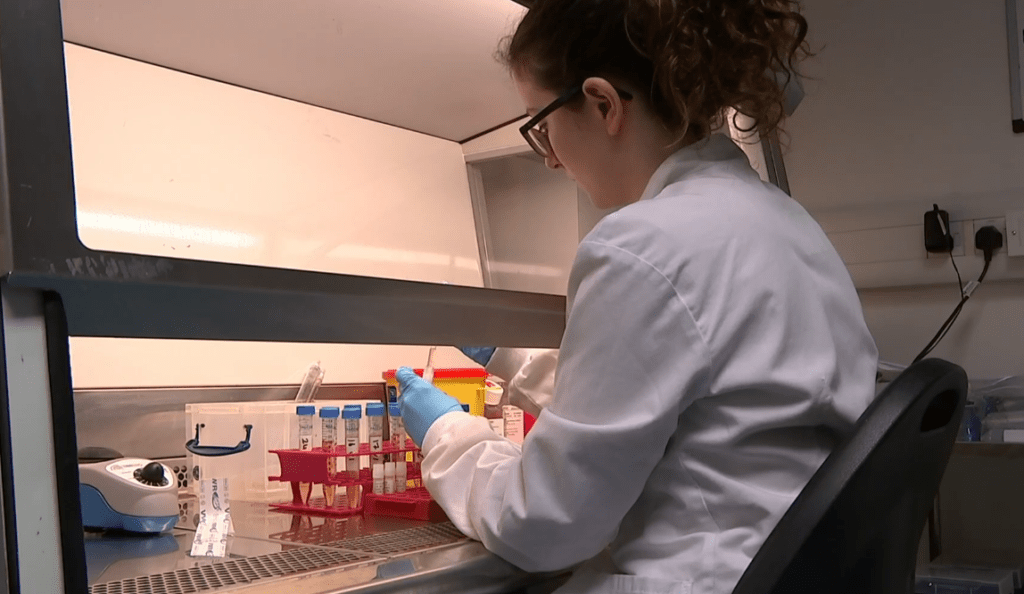
In one project, genetic fragments gathered from sewage systems in several nations are analyzed. Algorithms identify the anomaly if an unknown viral signature keeps showing up. Theoretically, weeks before hospitals start reporting significant clusters of illness, health officials could be notified.
The procedure has a strangely detective-like quality. Long before symptoms spread throughout cities, a virus leaves minute traces.
Additionally, the WHO has been working on a system known as Epidemic Intelligence from Open Sources, or EIOS. It looks for patterns that people might overlook by scanning news articles, online debates, and official health alerts worldwide.
a sharp increase in unexplained pneumonia cases. an increase in livestock fatalities. A collection of strange symptoms in a province that is rural.
On their own, these signals might seem insignificant. However, algorithms that link them across continents can occasionally uncover more concerning information.
The next pandemic is often referred to by researchers as “Disease X.” The name conveys a sincere concern despite sounding dramatic and almost cinematic. Scientists predict that there will eventually be another worldwide outbreak. They just don’t know which pathogen will be responsible.
It might be a different coronavirus. It might be influenza. or something completely different.
AI is being trained to investigate that ambiguity.
Scientists at Oxford and Harvard labs have created models that mimic potential viral mutations. The algorithms try to predict which mutations could help a virus evade immunity or spread more effectively by examining the genetic structure of pathogens.
Theoretically, vaccine developers could start creating countermeasures before harmful variants even emerge in the real world if the predictions come true.
It’s difficult to avoid feeling a peculiar mixture of hope and trepidation as these experiments take place.
When it comes to finding patterns in enormous datasets, artificial intelligence shines. Additionally, pandemics are fundamentally patterns—networks of infection that spread via human behavior, travel routes, and environmental factors. However, certainty and prediction are not the same thing.
Quietly, some researchers admit that the quality of the data fed into AI models continues to be crucial. Additionally, data on global health is still inconsistent. Certain nations have sophisticated surveillance systems. During outbreaks, others find it difficult to keep track of basic case numbers. As they say, “garbage in, garbage out.”
Deeper worries exist as well. Many AI models operate as “black boxes,” generating outcomes without providing a clear explanation of how they got there. That lack of transparency can be unsettling for public health officials who have to make life-or-death decisions.
It turns out that trust might be just as crucial as technology.
Misinformation during COVID-19 spread nearly as fast as the virus. Global reactions were complicated by political disagreements, conspiracy theories, and vaccine skepticism. Even the most advanced AI warning systems could fail, according to some researchers, if people don’t trust the signals they produce. Nevertheless, these initiatives continue to gain momentum.
Researchers worldwide are developing a new toolkit for outbreak prediction in labs, data centers, and epidemiology departments. algorithms that scan signals from the surroundings. Viral evolution is mapped by genetic surveillance networks. models that simulate how diseases might spread throughout urban areas.
As this develops, there’s a subtle realization that pandemic preparedness might soon look quite different.
